


Mica-Based Pearlescent Pigments can add a soft sheen, sparkle, and visual depth to your products. To reproduce these effects consistently in the finished product, choose the right combination of substrate, coating structure, particle size, and application grade.
What Are Mica-Based Pearlescent Pigments?
Mica-Based Pearlescent Pigments are effect pigments made by coating natural or synthetic mica flakes with materials such as titanium dioxide or iron oxides. They can be used in coatings, plastics, printing inks, and cosmetics to create pearl-like luster and optical depth.
Their structure can be understood in three parts:
- Mica substrate: The thin, platelet-shaped carrier that supports the coating layers.
- Optical coating: The coating material, thickness, and structure influence the reflected color and luster.
- Application-specific surface treatment: Some grades receive an additional treatment to address requirements such as dispersion, compatibility, or weather resistance.
The optical coating and the application-specific surface treatment serve different purposes. When selecting a grade, establish both the appearance it can produce and the formulation systems it is suited to.
Reflection and interference at different interfaces in the coating create the depth associated with a pearlescent effect. Simply blending ordinary Mica Powder with titanium dioxide powder cannot reproduce this controlled coating structure.
Not all pearlescent pigments are mica-based. Other substrates include glass flakes and alumina flakes. A similar appearance does not make them the same material.
How Do You Choose Between Natural and Synthetic Mica Substrates?
When comparing Mica-Based Pearlescent Pigments made with natural or synthetic mica, remember that substrate type alone cannot determine the finished appearance or the outcome of application testing.
Natural mica can be selected, processed, and coated to produce a wide range of established pearlescent products. Synthetic mica is manufactured under controlled conditions and can provide a cleaner base tone and more clearly defined colors in some grades.
Manufacturer product literature also positions Mica-Based Pearlescent Pigments made with synthetic mica for designs that prioritize transparency and color purity. Actual performance still depends on the specific grade and its coating process.
Do not assume that a grade is better suited to your project simply because it uses synthetic mica. Even with the same substrate, differences in particle size distribution, coating uniformity, and surface treatment can produce different results.
Likewise, identifying a substrate as natural or synthetic mica does not establish cosmetic suitability, weather resistance, or compliance with other application requirements.
What Do Color and Particle Size Each Contribute?
Describe the desired color and sparkle level separately when requesting samples. This makes it easier for your supplier to narrow the recommendations.
Silver-White Pearlescence: Assess Softness and Visible Graininess
Silver-white grades are useful when you want to retain the product’s original color while adding pearlescent depth. Examples include light-colored plastic packaging, decorative coatings, and cosmetics designed for a soft glow.
Look closely at:
- Whether the face-on appearance is bright enough.
- Whether the finish looks gray or dull from the side.
- Whether the surface shows a continuous soft sheen or distinct sparkle points.
- Whether the pearlescent effect obscures the original base color.
“Silver-white” does not describe a single, uniform appearance. Grades based on different substrates can look quite different. Decide whether you want a fine finish, a conventional pearl sheen, or pronounced sparkle.
Interference Colors: Evaluate the Base Color and Viewing Angle
Interference grades use an optical coating structure to produce a particular reflected color. The color of the dry powder may differ from the color it produces in the finished product.
The same interference pigment can look noticeably different over light and dark backgrounds. Request application samples with a base color close to the one you actually intend to use.
If you want pronounced color travel as the viewing angle changes, specify that separately. An interference color does not automatically mean a strong shift between multiple colors.
Colored Pearlescence: Judge the Overall Tone in the Formulation
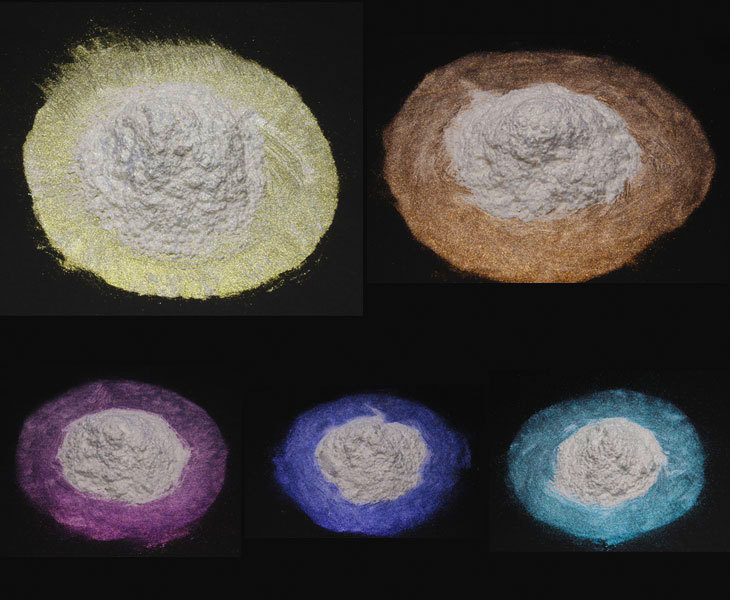
Gold, copper, reddish-brown, and other pearlescent effects can be created through different coating materials and structures. Some grades combine light interference with absorption.
Compare the overall tone in the complete formulation, rather than relying on the pigment’s color name. For example, a “gold” target might lean toward pale yellow, warm red, or bronze, each pointing to a different selection.
Manufacturer ranges often offer silver-white, interference, gold, and reddish-brown colors in several particle size options to suit different appearance requirements.
Particle Size: Focus on Fineness and Sparkle
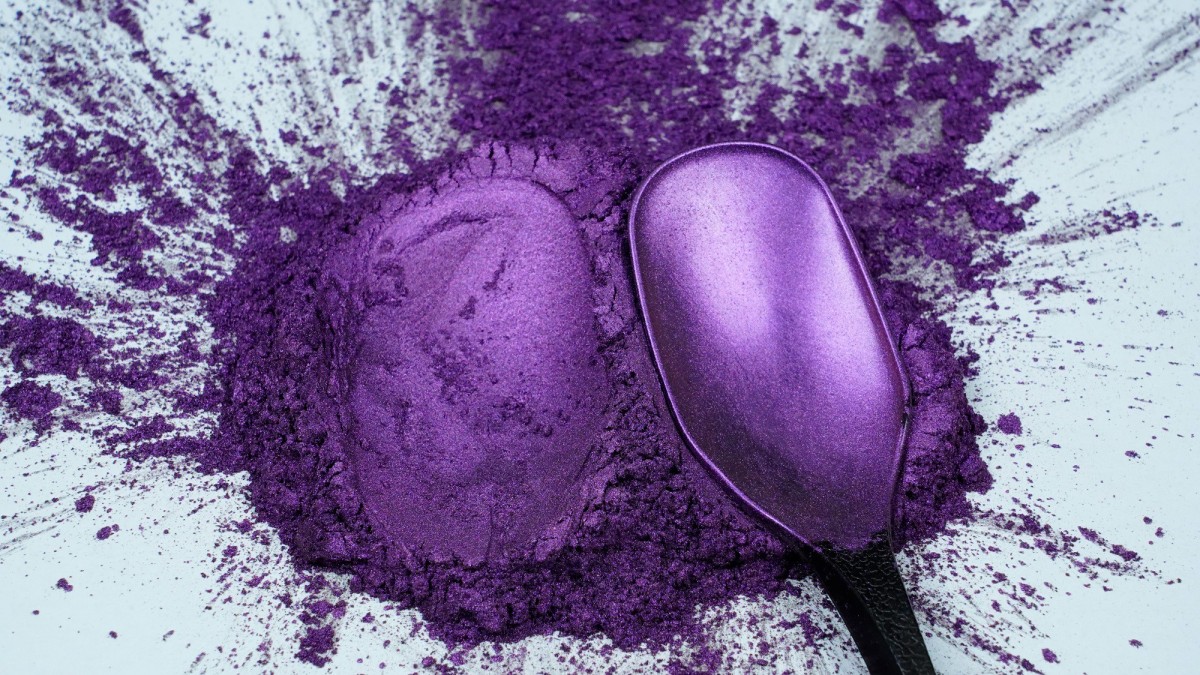
With other conditions comparable, finer platelets generally favor a smooth, continuous sheen, while coarser particles are more likely to produce distinct sparkle points.
However, a single particle-size value is not enough to select a grade.
Review the following:
- Particle size distribution: Similar central values can conceal different proportions of fine and coarse particles. Review D10, D50, and D90 together.
- D10: For a volume-based distribution, 10% of the total particle volume lies below this size. It helps characterize the fine end of the distribution.
- D50: The size below which 50% of the total particle volume lies; this is the volume median particle size.
- D90: The size below which 90% of the total particle volume lies. It helps characterize the coarse end of the distribution, but it is not the maximum particle size.
- Smaller D50, such as 5–15 μm: Generally associated with a soft, satin, fine appearance and relatively greater hiding power. Examples include cosmetics and inks designed for subtle pearlescence.
- Medium D50, such as 15–35 μm: Often associated with a conventional pearl sheen for general coatings and printing applications.
- Larger D50, above 35 μm: Generally associated with stronger sparkle, a metallic sparkle effect, and lower hiding power. Examples include automotive coatings and sparkling injection-molded parts.
- Coarse-particle control: Particularly important for thin films, fine printing, and products requiring a smooth feel.
- Measurement method: Results obtained using different methods should not be compared directly without checking their basis.
- Process limitations: The pigment must work within the requirements of your printing, filtration, or molding process.
Treat these D50 ranges as initial selection guidance, then confirm the result for the specific grade and formulation.
Larger particles do not necessarily produce stronger color travel. If angle-dependent color is the goal, compare the optical structure and samples viewed from several angles rather than simply selecting a coarser grade.
What Should You Check First in Each Application?
Coatings: Establish the Base Color, Film Thickness, and Service Environment
For decorative paints, packaging coatings, or industrial topcoats, first define where the pearlescent pigment will sit within the coating system.
Will it be incorporated into a colored topcoat or used in a transparent effect layer? What color is the primer? Will the finished product be used indoors or outdoors? Each of these factors influences grade selection.
Before preparing samples, specify:
- Whether the coating is waterborne, solventborne, or another type.
- The substrate and primer color.
- The application method and target dry film thickness.
- The desired soft sheen, sparkle, or angle-dependent color change.
- The weathering and chemical resistance required of the finished product.
For outdoor projects, shortlist grades designed for the relevant weathering requirements, then confirm performance through testing of the complete coating system. Pigment color stability alone cannot establish how the entire coating will perform after prolonged exposure.
Plastics: Evaluate the Effect in the Actual Resin and Molded Part
For caps, containers, household products, and other plastic parts, resin transparency and base color are important starting points.
Use the production resin for trials and make samples that closely represent the finished part as early as possible.
A flat color plaque is useful for initial color comparisons, but it may not reveal flow marks, weld lines, or localized appearance differences in a complex shape. Also check:
- Whether the pearlescent effect remains consistent across areas with different wall thicknesses.
- Whether curved surfaces and corners show noticeable changes.
- Whether the appearance remains stable as molding conditions are adjusted.
- Whether processing temperature and residence time stay within the limits for the specific grade.
If the pigment is introduced through a masterbatch, make the loading calculation explicit.
For example, if a masterbatch contains 20% pearlescent pigment and makes up 5% of the final blend, the final pigment content is approximately 1%: 20% × 5% = 1%. This is a calculation example, not a general loading recommendation.
Printing Inks: Match Particle Size to the Printing System
In packaging printing, a sample must do more than look bright and match the target color. The pigment must also transfer successfully onto the substrate.
Different printing processes impose different constraints:
- Screen printing: Match the pigment particles to the actual mesh opening size.
- Gravure and flexographic printing: Consider engraved cells, anilox rolls, and actual transfer conditions when choosing a grade.
- Thin ink films: Evaluate visible graininess, surface smoothness, and target luster together.
A more transparent ink vehicle generally makes the pearlescent effect easier to see, while the base color also influences the result. In screen printing, openings that are too small may block larger pigment platelets and impair transfer and print quality.
Provide the printing method, equipment conditions, substrate, and target sample together, rather than asking only which pearlescent powder is brightest.
Cosmetics: Consider Appearance, Skin Feel, and Application Area
For pressed powders, highlighters, eyeshadows, and other color cosmetics, start by defining the desired makeup effect.
For example:
- Pressed powders may prioritize a fine sheen and an even appearance.
- Highlighters may prioritize reflection intensity and sparkle.
- Eyeshadows may require a distinct pearlescent color or color travel.
Then compare spreadability, skin feel, and color performance in the actual formulation.
For cosmetic applications, also review the specific composition, INCI names and applicable CI information, impurity controls, and target market requirements. In the United States, for example, permitted uses for color additives can depend on the application area, including the eye area. A “cosmetic grade” designation does not establish suitability for every use.
Why Can the Finished Product Still Look Dull When the Color Is Right?
If the pearlescent effect is weak, the color looks muted, or the surface appears uneven, simply increasing the loading will not necessarily reveal the cause.
Appearance depends on the formulation’s transparency, platelet orientation, and processing as well as the pigment itself. Excessive loading can crowd the particles and reduce luster. Unsuitable aggressive grinding can also damage their platelet structure.
Work through the following checks:
These checks help separate pigment selection issues from formulation or process issues, so you can address the cause instead of repeatedly changing grades.
How Can Controlled Sample Trials Narrow Your Selection?
You do not need to test a large number of grades at once. Clear comparison conditions often make it easier to identify a suitable product.
Step 1: Describe the Target Effect Precisely
A description like the following is more useful than asking for “a brighter pearlescent powder”:
“We are developing light-colored plastic caps and want a fine, silver-white pearl sheen with as few visible coarse sparkle points as possible. We need to compare the appearance under our actual injection molding conditions.”
This specifies the application, base color, target effect, and processing conditions together.
Step 2: Prioritize One Variable at a Time
You can organize testing into successive rounds:
- First, compare grades based on different substrates but with similar colors and particle sizes.
- Next, compare different particle sizes within the same color family.
- Then, compare loading levels for the shortlisted grades.
If you change the pigment, resin, base color, and loading at the same time, even an improved result will be difficult to explain.
Step 3: Standardize Viewing Conditions and Record Specific Observations
Keep the light source, viewing angle, background, and film or part thickness as consistent as possible, and retain physical samples.
Go beyond “like” or “dislike” when recording results. Note:
- Deviation from the target hue.
- Luster intensity.
- Size of visible sparkle points.
- Surface uniformity.
- Processing compatibility.
- Differences from the target sample.
For products designed to change appearance with angle, a single photograph or viewing angle is not enough for a meaningful comparison.
Step 4: Calculate Cost per Acceptable Finished Product
Purchase price is only one part of the cost.
Also compare the actual loading needed to achieve the target effect, dispersion and processing requirements, and the consistency of appearance in production. A grade with a lower price per kilogram may not reduce finished-product costs if it requires a higher loading or leads to more rework.
What Documentation Should You Request for Mica-Based Pearlescent Pigments?
Once you have shortlisted candidate grades, request the following documents to support your internal assessment:
- Technical Data Sheet (TDS): Product characteristics, technical parameters, and application recommendations.
- Certificate of Analysis (COA): Actual test items and results for the supplied batch.
- Safety Data Sheet (SDS/MSDS): Handling, storage, and related safety information.
- Heavy metals test reports for cosmetic grades: Supporting information for the relevant raw material review.
- Applicable certification and compliance documents: Check their scope against the specific grade and sales market.
These documents serve different purposes. A COA does not replace full application performance testing, and an SDS does not establish suitability for a particular cosmetic use.
Pritty can provide COAs, TDSs, and SDSs/MSDSs for the relevant industrial, weather-resistant, and cosmetic grades. Heavy metals test reports are available for cosmetic grades. HALAL, KOSHER, and REACH-related documentation can also be provided according to project needs, subject to the grade and the scope covered by each document.
If you are selecting Mica-Based Pearlescent Pigments, share your formulation system, target effect, processing conditions, and sales market with Pritty. Include your current grade or a target sample if available. This helps us identify more relevant candidates and plan the next stage of sample testing and document review.
By clicking 'Allow All', you agree to the storage of cookies on your device to enhance site navigation, analyze site usage and assist with our marketing efforts.